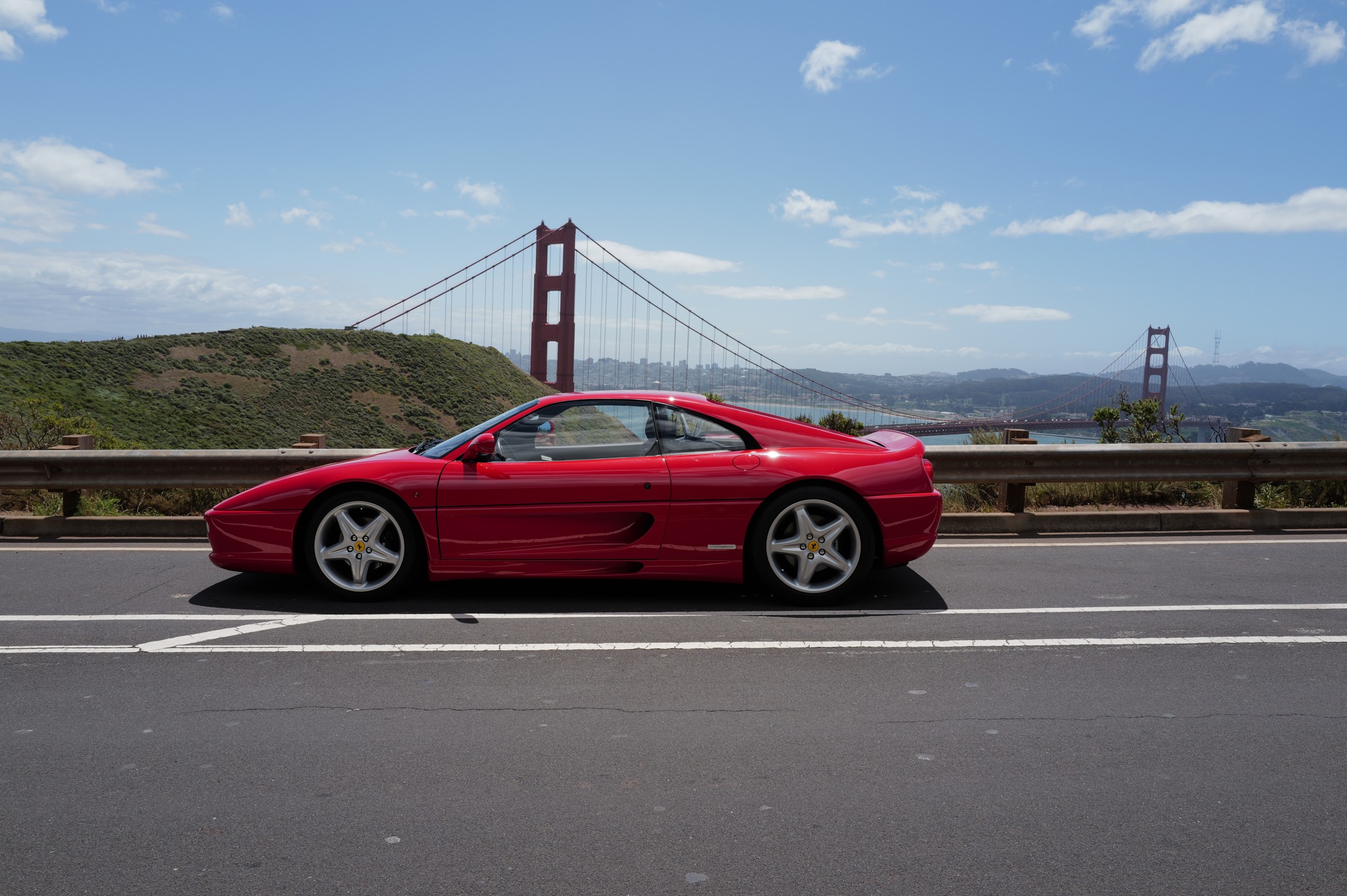
The F355 is easy to remember as a shape and a sound. Its place in Ferrari's history is more substantial: it showed how much the company could change while preserving the compact, mid-engined V8 formula that enthusiasts already understood.
Launched in 1994, it grew from the 348 during the early years of Luca di Montezemolo's return to Ferrari. The connection between the car and the chairman is real. The more interesting story is how a change in priorities became visible in the product.
Why Luca's arrival was a return
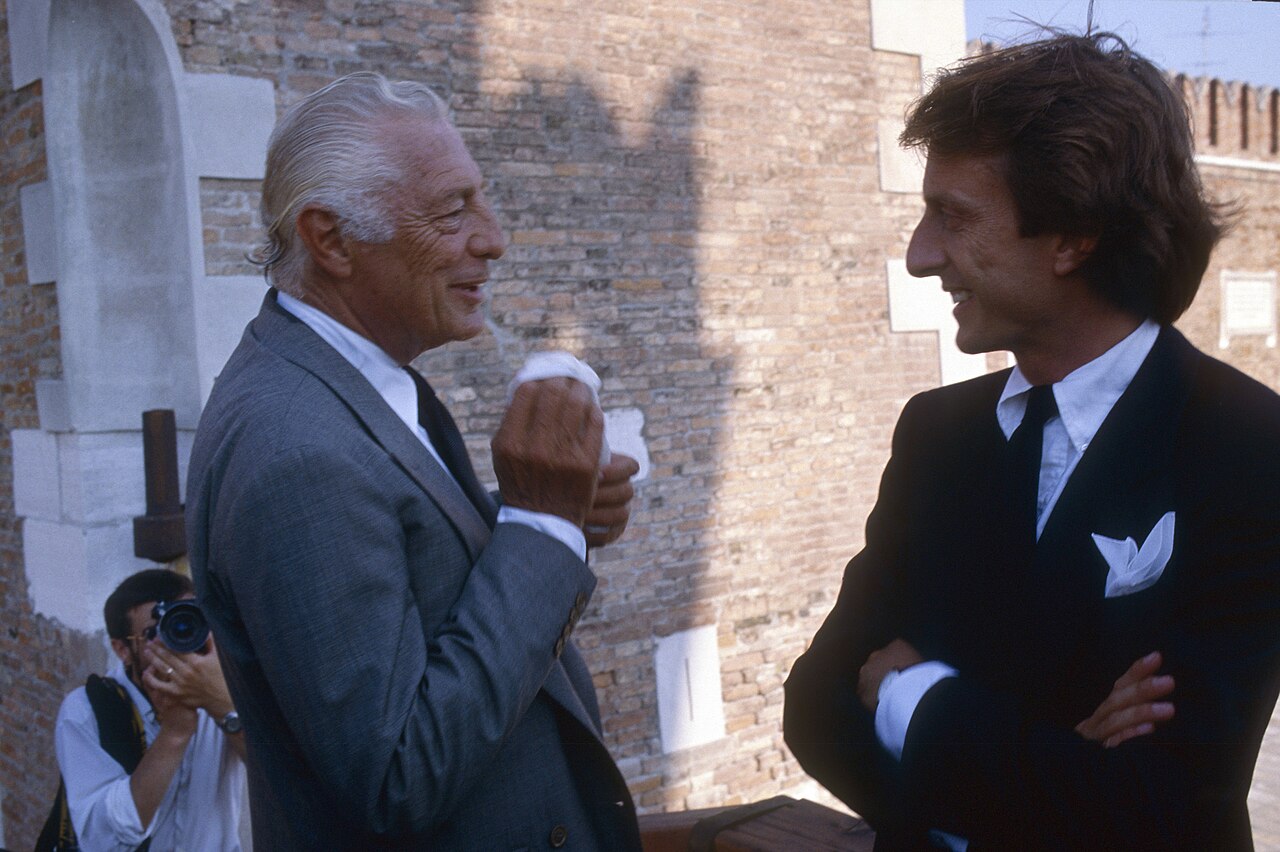

Montezemolo had joined Ferrari in 1973 as Enzo Ferrari's assistant and then managed the Formula One team during the 1970s. He returned as chairman in November 1991 after working elsewhere. Ferrari's published management biography records that earlier connection and the date of his return.
He therefore arrived with a relationship to the founder's era, but inherited a company that needed to compete in a changed world. Ferrari's own account of the 1991 racing season describes a winless campaign, internal conflict and his appointment at the year's end. The badge alone could not supply the results.
On the road-car side, customers also had alternatives. A Ferrari could still be an emotional purchase, yet buyers could reasonably expect the rest of the experience to justify the price. That tension helps explain the F355 more clearly than the familiar story of a powerful executive simply ordering a better car.
The brief changed: listen to the owner
Contemporary evidence is particularly revealing. In its July 1994 F355 report, Motor Sport described Montezemolo discussing reorganized design and production teams, new processes and quality. It also reported that Ferrari had researched what customers wanted: a car they could use in varied conditions, with performance accompanied by comfort, predictable behavior and sensible ergonomics. The report explicitly placed the Honda NSX among the competitive pressures. Read the period report.
Our interpretation is that this was Montezemolo's most consequential influence on the F355: making the owner's experience part of the engineering brief. A spectacular engine could still be central, while steering effort, shift quality and confidence on the road received attention of their own.
That does not make him the car's designer or engineer. It makes him the leader responsible for setting expectations and organizing a company capable of delivering them.
The 348 supplied the foundation
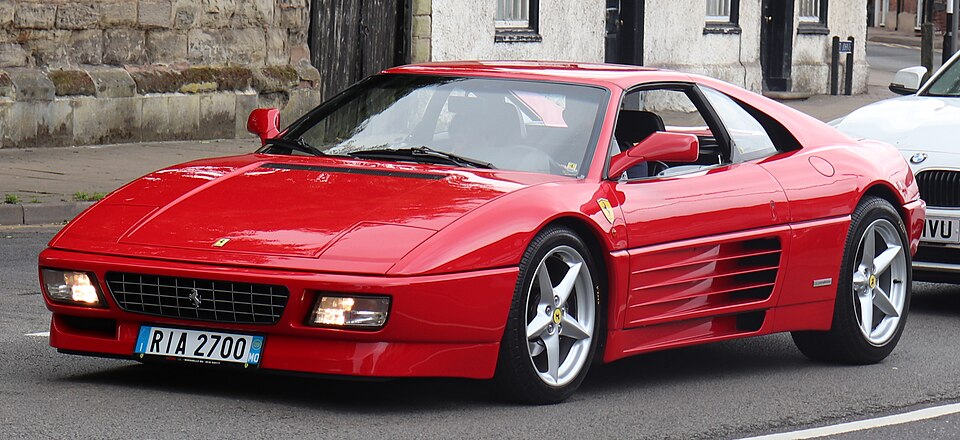

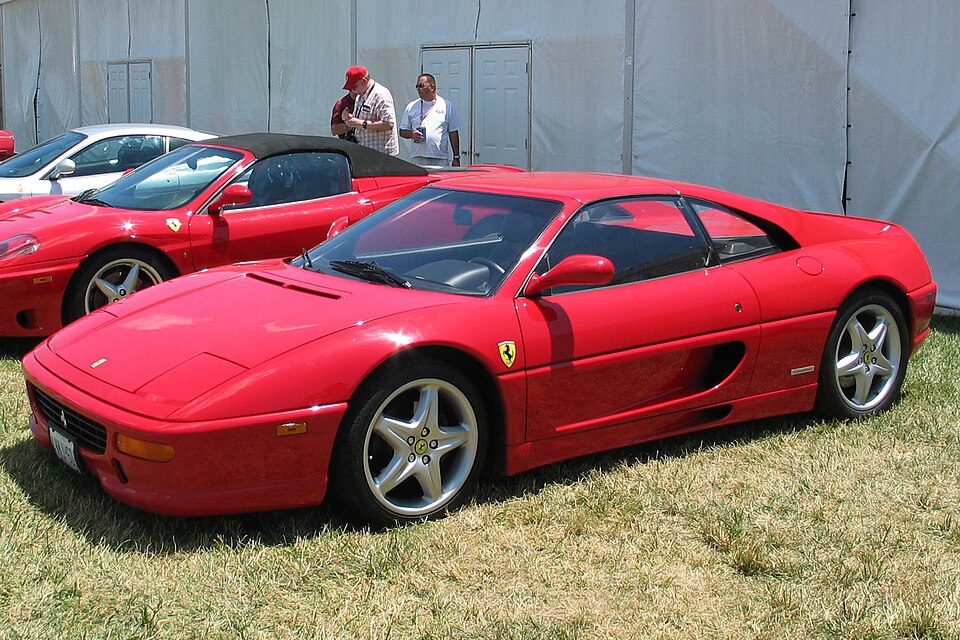

Ferrari's own retrospective states that the F355 was mechanically based on the 348. The new car was an extensive evolution of an existing architecture, which makes the scale of the change particularly interesting. Ferrari's F355 anniversary account explains that relationship.
It is also unfair to treat the 348 as one unchanging specification or merely the failed car before the good one. Development continued: Ferrari lists the later 348 GTB with 320 CV, compared with the 300 CV commonly quoted for the earlier TB. A comparison should identify which 348 it means. Factory 348 GTB specifications.
The 348 also helped establish a part of Ferrari ownership that would outlast either model. Ferrari Challenge began racing in 1993 with the 348. Owners could participate in a factory-organized competition environment as well as buy a road car. That is an important contribution from a generation too often reduced to its successor's backstory. Ferrari's history of the Challenge series.
What the F355 changed
A different engine character
Capacity increased from 3.4 to 3.5 liters, and the F355 adopted five valves per cylinder. Ferrari quoted 380 CV, approximately 375 mechanical horsepower, with peak power at 8,250 rpm. Titanium connecting rods and extensive engine revisions supported the high-revving design. The name itself reflects 3.5 liters and five valves. Ferrari's technical retrospective and factory specifications give the details.
The figures explain part of the attraction. The rest is the prospect of using an engine that invites the driver to explore its rev range. For an enthusiast, that is a different pleasure from simply owning the largest number in a specification table.
Six speeds, assistance and attention underneath
The F355 gained a six-speed manual, standard power assistance for the steering and electronically controlled dampers. Work on the underbody aerodynamics contributed to high-speed stability. These were changes to the way the car worked, not just its headline output. The 1994 launch report documents them and credits Pininfarina's involvement in the aerodynamic development.
The principle still feels relevant: performance becomes more useful when the driver can place the car confidently and operate its controls without unnecessary effort. Different enthusiasts may prefer the heavier, more direct demands of an earlier car, but greater accessibility does not automatically mean less character.
A calmer exterior
The F355's cleaner surfaces and more rounded treatment gave it a different visual personality from the 348's straked sides. Ferrari's own retrospective describes the return toward the styling language of earlier V8 models. Today, the restraint is part of the appeal: the car is recognizable without needing a large wing or an elaborate graphic treatment.
Progress did not stop at launch
The F355 range continued to develop. Most visibly, the 355 F1 arrived in 1997 with paddle-controlled electrohydraulic shifting. Ferrari was willing to put a new control system into a car whose traditional gear gate had already become part of its identity. Ferrari's record of the 355 F1 launch.
That creates an appealing contradiction for a present-day collector. A gated F355 represents a much-loved way of operating a sports car. An F1 example represents Ferrari's determination to move beyond it. Both belong to the model's authentic history. Our F1 transmission history follows that second path.
Montezemolo's impact beyond one model
_-_Schumacher,_Barrichello,_Todt,_Montezemolo.jpg)
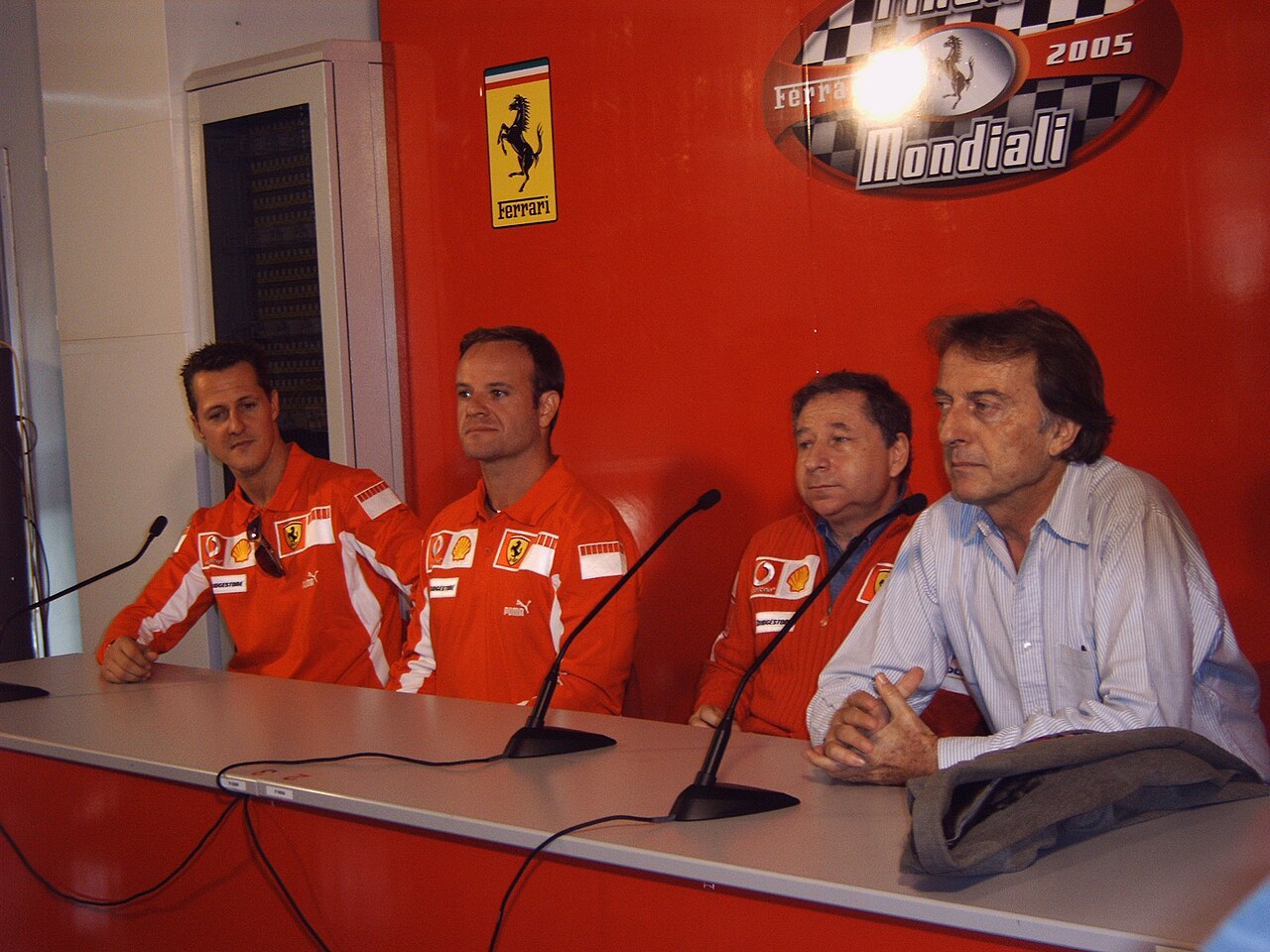
On the racing side, the rebuilding included bringing Jean Todt to Ferrari in 1993 and subsequently assembling the organization associated with Michael Schumacher's championship years. A contemporary account by Joe Saward records the Todt appointment and the organizational work behind it. The period reporting provides useful context.
Ferrari's official chronology records the eventual run of six consecutive constructors' titles and five consecutive drivers' titles. Those achievements came years after the F355's introduction. They are evidence of the longer rebuilding effort, rather than results that should be projected backward onto the 1994 launch. Ferrari's historical timeline.
When Montezemolo announced his departure in 2014 after almost 23 years as chairman, he credited the people in the factories, offices and racing teams for the company's growth. That is a useful corrective to the idea that any one person created the revival alone. His departure statement is preserved in the FCA archive.
Our reading of his legacy is that he helped connect the Ferrari people wanted to imagine with the Ferrari the company had to build and support. The F355 is an early, tangible example of that ambition.
Why that history matters to an owner
The F355 makes sense as more than a beautiful interval between the 348 and 360. It belongs to a moment when Ferrari was reconsidering how its cars should fit into an owner's life, while still making room for sound, speed and mechanical involvement.
That history does not replace due diligence on a car now three decades old. The specification, maintenance and quality of previous work still determine the ownership experience. Read our F355 model guide, the early-versus-later electronics article, and our discussion of F1-to-manual-control conversions alongside the story.
A well-chosen F355 offers a chance to experience that change in priorities from the driver's seat. Its significance is that the evolution was something an owner could use.