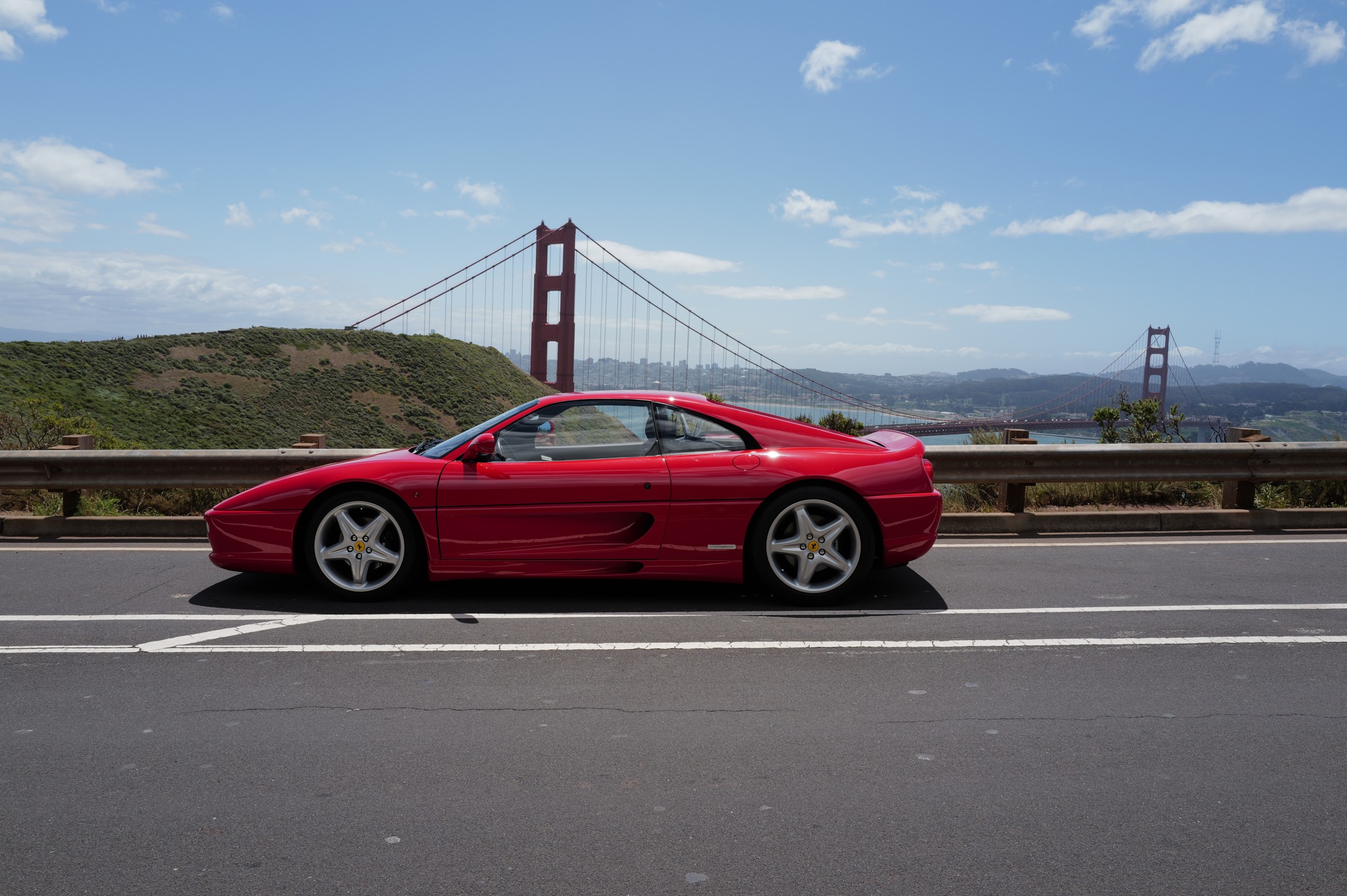
A Ferrari's shift paddles tell only part of its story. A 355 F1, a 430 Scuderia and a 458 Italia all let the driver request a gear with a fingertip, but the hardware and the experience behind that request changed substantially.
Following that development explains why an early F1 Ferrari can feel so different from a later dual-clutch car—and why the early systems deserve to be understood in their own period.
1989: the racing breakthrough
Ferrari had explored hydraulic gear-change control in the late 1970s, but the defining competitive moment arrived with the 640 in 1989. John Barnard's project brought steering-wheel paddles and electrohydraulic shifting to Ferrari's Grand Prix car. Nigel Mansell won its debut race in Brazil.
The season also exposed the difficulty of making a new system reliable. Its lasting contribution was the control layout: the driver could change gear while keeping both hands on the wheel. Ferrari's history of the semi-automatic gearbox follows both the experiments and the eventual breakthrough.
There is a useful distinction here. The production car that followed inherited an idea and development knowledge from racing. It did not receive a Grand Prix gearbox transplanted into a road chassis.
1997: the 355 F1 brings paddles to the road
The F355 initially arrived with a six-speed manual. In 1997, the 355 F1 added electrohydraulic control of gear selection and clutch operation. The core gearbox remained a manual design; the automation performed the driver's usual clutch-and-lever work. Ferrari's 1997 history records the launch, while its technical retrospective explains the shared gearbox.
That architecture is why a two-pedal F355 should not be understood as a conventional automatic. During a change, the system still has to release the clutch, select a gear and restore drive. The driver can feel a distinct shift event. The ambition was to automate a demanding task and make race-inspired controls available to road-car owners.
For collectors, the F1 version now has its own historical identity: it represents Ferrari's first production paddle-shift chapter. Choosing one need not be explained solely as settling for a car without the gate.
The 360: development becomes part of the car
The 360 Modena arrived in 1999, followed by the road-focused Challenge Stradale in 2003. Those dates place the 360 generation between the pioneering 355 F1 and the more integrated electronic era that followed. Ferrari's official historical timeline locates both models in that sequence.
F1 remained an automated-manual approach. Its refinement depended on coordination: engine response, the point at which the clutch engaged, and the timing of selection all contributed to the result. Faster selection alone could not explain everything a driver felt.
That also makes “a 360 F1” an incomplete description of a used car. Ask which control unit and software it has, whether they match the car, and what the service records say about setup and repairs. Treat any claimed upgrade as something to document, rather than assuming every car with the same badge will behave identically. Our 360 model guide provides the wider buying context.
The V12s join the story
In 2002, the 575M Maranello became Ferrari's first twelve-cylinder road car offered with an F1-type gearbox. Ferrari's contemporary launch material described both conventional manual and electrohydraulic versions. The original Ferrari press material is reproduced in this archive.
This widened the technology's role. A mid-engined V8 and a front-engined V12 grand tourer could share the idea of paddle operation while asking different things of the calibration. A system that suited a hard acceleration run also needed to manage the ordinary junctions and traffic of an owner's journey.
The F430: transmission and chassis work together
Introduced in 2004, the F430 brought an electronic differential and the steering-wheel manettino into the road-car range. Ferrari quoted 150-millisecond shifts for its F1 gearbox. The direction was becoming clear: the transmission was part of a coordinated set of vehicle controls. Ferrari’s August 2004 launch release, preserved in this archive, describes those developments.
SuperFast: reducing the interruption
With the 599 GTB Fiorano, Ferrari described F1-SuperFast changes taking 100 milliseconds, achieved by overlapping parts of the shift sequence. Its later 612 Scaglietti documentation also described SuperFast operation. These remained automated-manual systems. Ferrari's 2010 range brochure explains the strategy.
The 430 Scuderia, introduced in 2007, pushed this development further with F1-SuperFast2. Ferrari quoted a 60-millisecond shift figure, with engine and transmission management coordinating operations that had previously occupied more of the sequence. Ferrari's Scuderia technical release describes the system.
Those are manufacturer figures under the relevant operating conditions. They should not be read as stopwatch promises for every upshift in traffic, or compared casually with another maker's figure measured differently. Their significance is the direction of development: less interruption, more coordination and a smaller separation between one gear and the next.
2008–2009: the dual-clutch change
The California introduced Ferrari's seven-speed dual-clutch transmission in 2008. The official Ferrari Lake Forest model history identifies that first. The 458 Italia followed in 2009 with a seven-speed DCT, described in its original launch material, preserved in this archive.
This was a different mechanical solution. Instead of opening and closing one clutch through every shift, a dual-clutch arrangement can transfer drive between two clutch-controlled gear paths. That overlap greatly reduces the interruption felt during a change. It helps explain the combination of rapid response and smoother progress associated with this generation.
Ferrari continued to use “F1” in descriptions of dual-clutch gearboxes. Its 458 specifications describe a dual-clutch F1 gearbox. Consequently, the word F1 in an advertisement does not, by itself, identify the older single-clutch architecture. Model and specification matter. The 458 launch specifications identify the system.
Eight speeds and closer integration
The SF90 Stradale introduced Ferrari's redesigned eight-speed, oil-bath dual-clutch transmission. Later applications adapted that architecture to different cars: Ferrari's Roma Spider material, for example, explains changes to ratios and the provision of a mechanical reverse gear relative to the SF90 arrangement. SF90 technical release; Roma Spider technical release.
The 12Cilindri also uses an eight-speed DCT, with Ferrari describing changes to ratios and shift performance for the V12 application. The enduring paddles now command a transmission integrated into a much more extensive network of vehicle controls. Ferrari's 12Cilindri specifications describe that development.
Choosing the experience, then checking the car
A buyer does not have to treat the entire chronology as a ranking. The open gate provides a task to perform. An early F1 system preserves a particular moment in Ferrari's technical history. A later DCT offers another kind of coordination and response. What you enjoy may be different from what produces the shortest published shift time.
Condition still has to be assessed on the individual car. Have a specialist identify the system, review its maintenance and diagnostic history, and demonstrate its behavior cold and fully warm. A pause inherent in the design and a developing fault are different things; a seller's assurance that “they all do that” cannot distinguish them.
For owners drawn to a third pedal, our F355 and 360 manual-conversion article explains the work, costs and market distinctions. For the car that first brought F1 paddles into series production, read the F355's place in Ferrari's revival.