
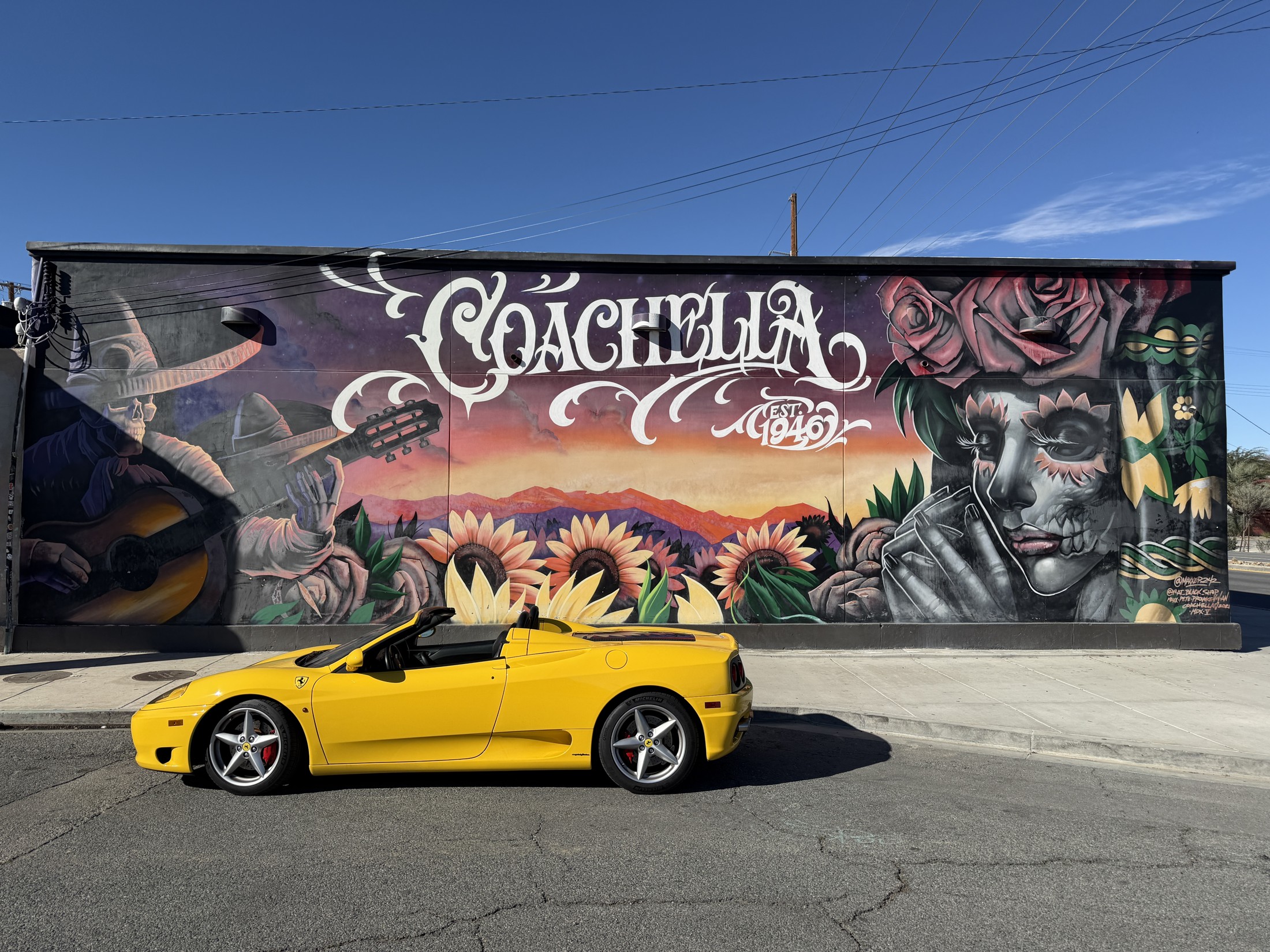
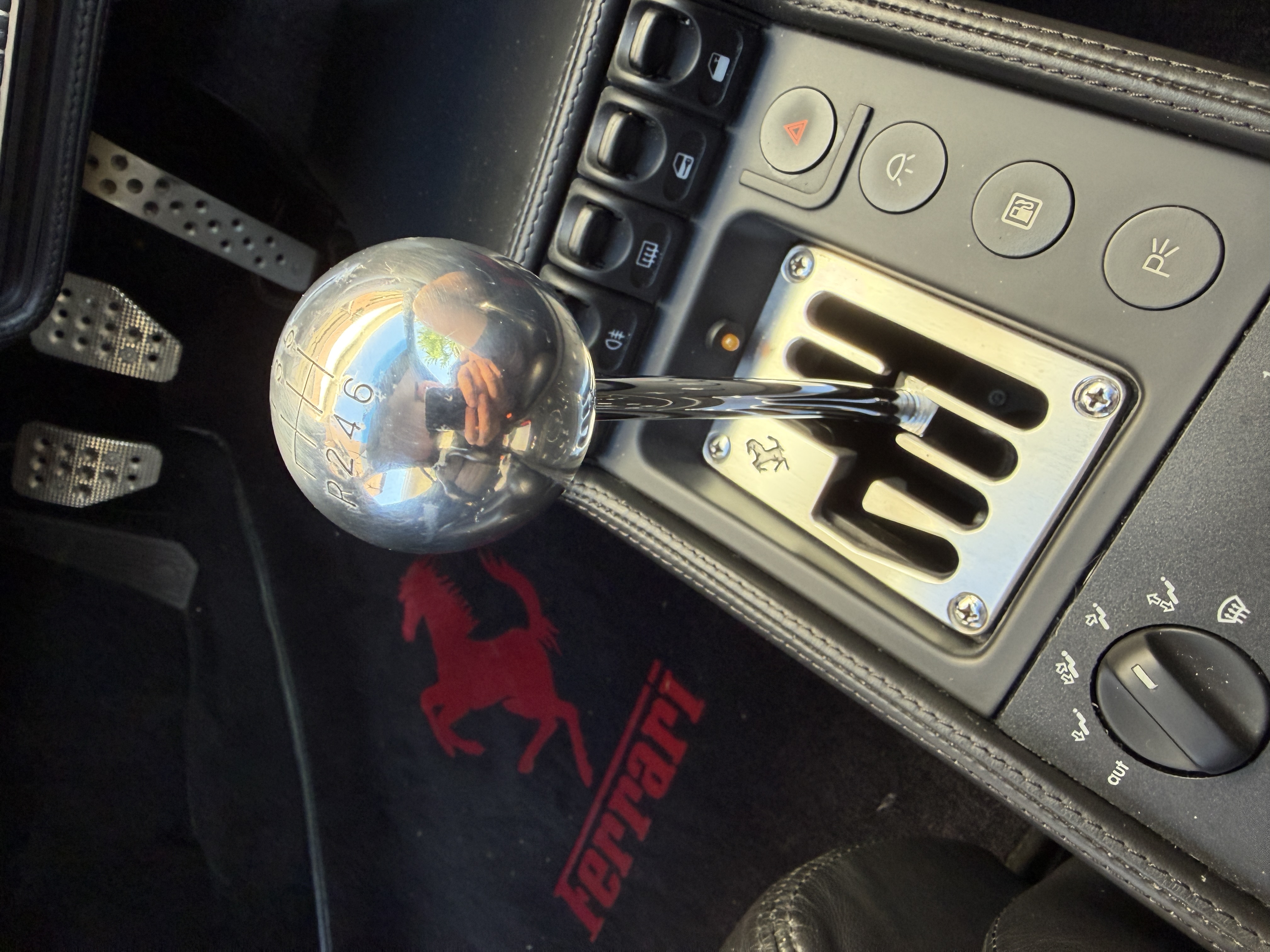
A polished gate and a third pedal can change the reason someone wants a Ferrari. They also raise a question that a photograph cannot answer: did the car leave Maranello that way?
For F355 and 360 buyers, a well-executed change from F1 paddles to manual controls can be an appealing route to a more physical driving experience. Understanding what the work involves helps separate a convincing driver's car from a tempting price and a shiny gear lever.
Updated October 7, 2026, with specialist pricing and a more detailed look at the F355 and 360.
What changes when F1 becomes manual?
The starting point is often misunderstood. These Ferraris did not use a conventional torque-converter automatic. Their F1 systems operated a manual gearbox through electronically controlled hydraulic actuation. Ferrari's own account of the 355 F1 explicitly describes the underlying gearbox as the same as the manual's. The driver requested a shift with a paddle; the system handled the clutch and gear selection. Ferrari explains the original arrangement here.
That makes the owner's observation that “it was a manual underneath” mechanically meaningful. It does not make every F1 car a factory gated manual, and it does not mean that fitting a lever is the whole job.
Enthusiasts use both “manual swap” and “manual conversion.” We use F1-to-manual-control conversion when the existing gearbox is retained and its operation changes. “Gearbox swap” fits a job that actually replaces the gearbox. Both approaches exist: one documented F355 auction car received a manual transaxle from a donor car. The invoice should settle the terminology, rather than the terminology making assumptions about the invoice.
More than a gate and a pedal
A coherent installation must make the controls, clutch actuation, gear selection and electronics work together. The parts chosen and the work required differ between the F355 and 360, and between suppliers. A package for one model is not a parts list for the other.
For example, MMWX lists a shift tower, selector components, cables and linkages, clutch hydraulics, a wiring harness and software among its 360 conversion components. SBR describes its own 360 work as an in-house installation using a combination of factory and manufactured parts with ECU changes. Those descriptions show why the electronics and the mechanical assembly both belong in the conversation. MMWX's component description and SBR's service description explain their respective approaches.
Ask the installer to identify precisely what stays, what is replaced, how the clutch is operated, and how the car's original electronic functions are retained. A receipt reading only “manual conversion” leaves too much of the interesting work unexplained.
How good have they become?
The encouraging development is the availability of complete, repeatable packages. Purpose-made selector components, dedicated harnesses, model-specific software and published warranty terms make this a more structured proposition than an improvised collection of used parts. MMWX emphasizes its software integration; EAG advertises chassis-specific ECU preparation and a two-year parts-and-labor warranty for its conversion offering. These are supplier descriptions, rather than independent proof that every installation will be trouble-free. EAG's current 360 offering sets out its scope.
Our view is that a good conversion deserves to be judged as a finished car. Does the lever find each gear positively? Is clutch engagement progressive? Does it behave consistently once warm? Are there warning lights, disabled functions or unresolved diagnostic faults? Can the owner explain who will support the installation in three years?
There is no need to promise that a converted car will feel identical to every factory manual. Pedal geometry, linkage adjustment, component choices and the condition of the underlying transmission all matter. A satisfying result is one that feels deliberate and complete, backed by a specialist willing to stand behind it.
An owner's perspective: Darin's 360 Spider
From Darin, TRATTO's founder:
I own a Ferrari 360 Spider that was converted to manual using a Cambio Manuale kit about a year ago. From my own experience, I can't tell a difference between it and the factory manual version.
That is one owner's experience of a particular car, and it gives the discussion something more useful than a theoretical argument about pedals. A well-finished installation can satisfy the person driving it even though its original specification remains different.
Does Cambio Manuale use factory OEM parts?
Some, but the kit is not entirely factory Ferrari parts. Cambio Manuale's own website says its kits combine new Ferrari parts with new aftermarket parts. It also explains that components can change as original Ferrari items become unavailable. The accurate description is a mixed-parts conversion package, not an all-OEM Ferrari kit. Cambio Manuale's manufacturer description and FAQ.
The company's current catalog cannot establish every component installed in Darin's car about a year earlier. The invoice or installer-supplied parts list would be the evidence for that particular installation. Likewise, language such as “OEM-level” describes a claimed standard of quality; it does not establish who manufactured a part.
What does it cost?
These are advertised prices checked October 7, 2026, not quotes for a particular car. Keep parts-only prices separate from installed packages, and compare prices in their original currencies before adding taxes, transport or import costs.
Ferrari 360: a documented $25,000 installed starting point
Normal Guy Supercar lists its F430/360 conversion at $25,000, with a stated split of $13,000 for parts and $12,000 for installation. Tax and shipping are additional. Its page lists an additional $7,000 for its full clutch-replacement package and says unforeseen repairs cost extra. That puts the advertised conversion plus that clutch option at $32,000 before tax, transport and other work. Its stated two-year warranty covers the conversion, not the whole car. See the supplier's current package and exclusions.
MMWX also publishes a $25,000 conversion service and separately lists a $12,500 assembly for outside installation. The distinction matters: a box of parts is not a finished, commissioned car. Obtain a written scope identifying software, labor, testing and any clutch work before comparing two proposals. MMWX pricing and service details.
Cambio Manuale lists its 360 base kits at $14,800 or $14,900, depending on the clutch-hydraulic version. Programming and other options are separately priced; these are parts prices before installation and applicable taxes. They are current advertised figures, not what Darin paid for his earlier installation. Cambio Manuale's price list.
Ferrari F355: obtain a separate, model-specific quote
The F355 should not inherit the 360's budget by assumption. Eurospares lists its left-hand-drive F355 manual conversion kit, part EAP1552479, at £21,000 excluding VAT, new to order and subject to availability. That is a kit listing, not an installed US price. Labor, the exact contents, any additional donor parts, shipping and taxes must be established separately. Eurospares' F355 kit listing.
We did not establish a sufficiently clear, current F355 installed package to present a universal dollar figure. A detailed estimate for the actual car is more useful than a broad range borrowed from a different Ferrari.
Where do converted cars sit in the market?
Think of three separate purchases: an original F1 car, a car converted to manual controls, and a factory manual. They may deliver overlapping pleasures, but they do not have identical histories.
CLASSIC.COM maintains a separate 360 manual-conversion category and describes these cars as typically trading below factory-original manuals. It also cautions that the category mixes Modena, Spider and Challenge Stradale examples. That mixture makes a headline average a poor valuation tool for an individual car. Its market classification is useful context; comparable completed sales still need to match the body style, mileage, condition and quality of the work.
Strong individual results do exist. A converted 1998 F355 Berlinetta reached a $253,000 winning bid on Bring a Trailer on April 25, 2026. It had a donor manual transaxle, extensive engine work and other modifications. That is a specific auction result before buyer fees, not the value of an ordinary converted F355 or proof that the conversion alone created the price. Read the car's complete auction history and specification.
For someone who wants to drive rather than preserve an original specification, a properly documented conversion can be attractive. For someone collecting a rare factory configuration, the same car answers a different question. Neither buyer has to be wrong.
The calculation before commissioning the work
Add the purchase price, inspection, conversion, transport and any deferred maintenance. Then compare that total with an already-converted example and with the factory manual you would actually consider buying. Include the time the car will be away and the support available near home.
If you already own a sound F1 Ferrari with a history you trust, keeping that known car may be the strongest argument for changing its controls. If you are buying solely to convert and resell, do not assume the next owner will reimburse every invoice. Spending and market value are different numbers.
Keep the original F1 components where practical, label them, and record the work with dated invoices and photographs. Retaining parts helps preserve options, but it does not automatically make a future reversal simple or inexpensive.
What a buyer should receive
- Original specification: clear disclosure that the car was built with F1 operation, plus the conversion date and mileage.
- A complete work record: installer, parts supplier, retained or replacement gearbox, clutch work and software changes.
- Evidence of use: subsequent mileage, servicing and any adjustments since completion.
- A support plan: warranty scope, transferability and access to replacement parts.
- An independent inspection: assessment of both the installation and the Ferrari around it, including a road test and appropriate diagnostics.
The appeal is straightforward: a Ferrari you want to drive, with the controls you want to use. The best examples let the workmanship and the history make that case without pretending to be something they were never built as.
Continue reading
Explore our F355 guide and 360 guide, or follow the evolution of Ferrari's F1 transmission. For the car's broader story, read how the F355 grew from the 348 during Montezemolo's return.
Sources are linked beside the relevant facts. Supplier claims and prices describe advertised offerings; they are not TRATTO workshop tests or endorsements.