Character
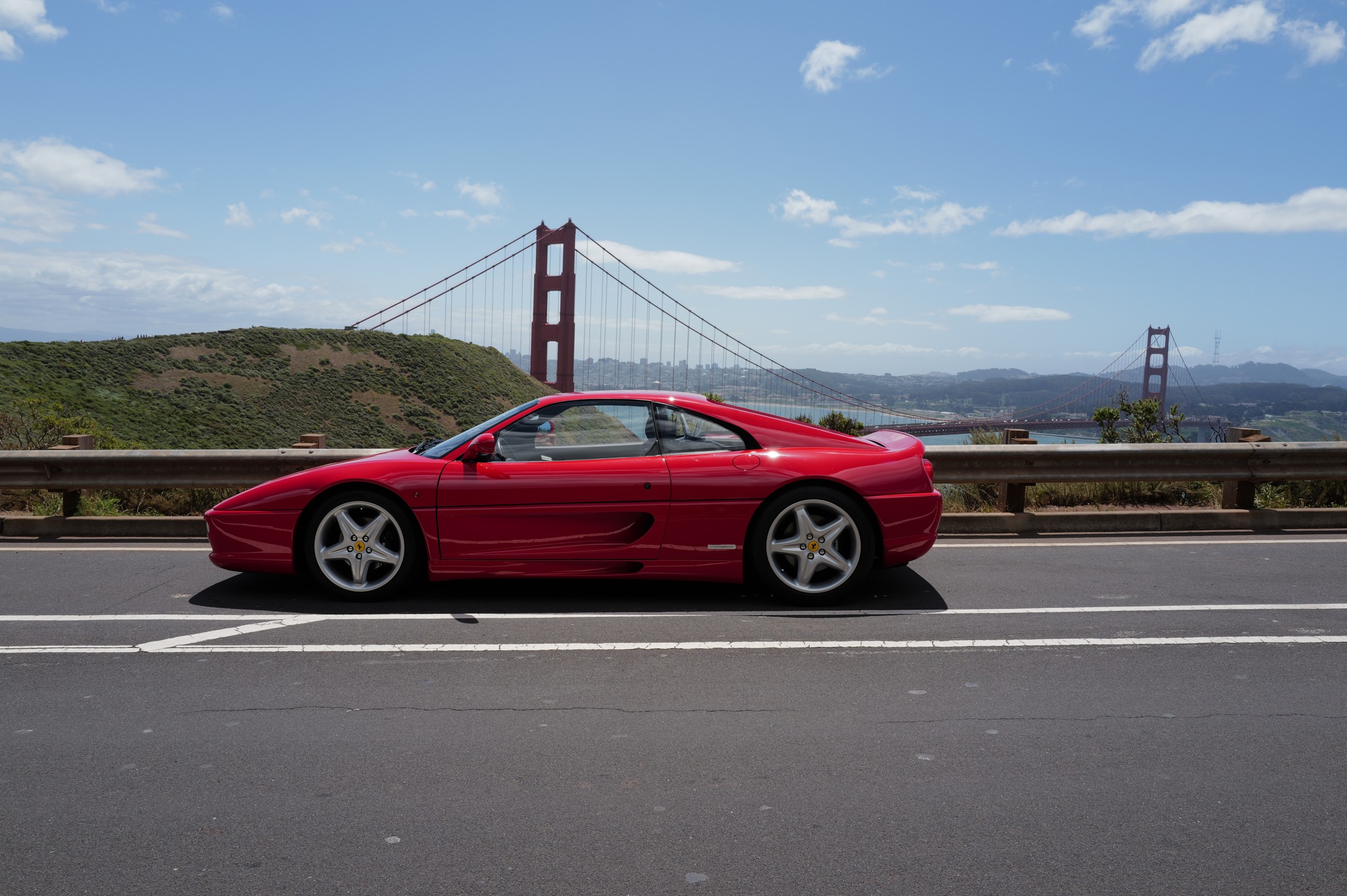
The F355 brings together the proportions, sound and visible controls that draw many enthusiasts towards a 1990s Ferrari. Its low nose and compact body give the design a clarity that works equally well in a quiet photograph or a line drawing. For a prospective owner, the appeal often starts there: a car to look back at after parking, and a reason to take the longer route home.
Ferrari introduced the F355 in 1994. Its rear-mounted 3.5-litre V8 used five valves per cylinder, and the model later brought Ferrari’s F1-style paddle-operated transmission to a road-going production car. Ferrari’s own retrospective places the F355 at an important point in the evolution from the 348 to the later V8 cars. Ferrari’s F355 history.
Body styles
The Berlinetta is the fixed-roof coupé. The GTS has a removable roof panel, while the Spider provides a folding soft top. These are meaningful choices about how you will enjoy the car, rather than a simple hierarchy. A buyer drawn to the coupé’s roofline may want a different experience from someone planning open-air summer journeys.
Spend time with the particular body style before deciding. Sit in it, check the driving position, and consider where the car will be parked and how often it will be used. For a GTS, include the roof panel, fit and seals in the inspection. For a Spider, arrange a complete demonstration of the roof and review any work to the mechanism and trim. Ferrari’s model retrospective outlines the three body configurations.
Transmissions
The six-speed manual and the later F1 system offer different kinds of involvement. Ferrari introduced the F1 version in 1997, bringing paddle-controlled shifting to the model. A prospective owner should experience the relevant transmission in normal driving and manoeuvring, with a specialist interpreting anything that feels unfamiliar. Ferrari’s 355 F1 record.
A manual conversion adds another layer to the history. Establish how the car left the factory, who carried out the work and which components and procedures were used. Request invoices and a current inspection of the completed installation. A converted car may fit your preferences very well, but record it as a conversion when comparing it with a factory manual.
Our guide to manual conversions explains how to organise that evidence. We treat transmission origin and present operation as separate questions, so both remain visible when researching a car.
A little more clarity
Common questions
How should I compare a factory manual with a conversion?
Keep two descriptions: how the car was built and how it is configured now. Assess the conversion’s records and workmanship, and compare it with other documented conversions as well as factory manuals.
What should a service invoice tell me?
The date, mileage, parts, operations completed and any remaining recommendations. If the seller describes a major service, ask the workshop to explain its scope for this chassis.
Are the photographs evidence of a particular car’s condition?
They are model illustrations. Assess a car for purchase using its own recent photographs, records and independent inspection.
OBD-I and OBD-II
Engine management is another part of choosing an F355. Our Motronic 2.7 and 5.2 guide explains the two diagnostic systems, readiness checks, and questions to ask about sensors, exhaust equipment and power claims.
Valve guides
Valve-guide wear is a recognized inspection concern on the F355, especially in discussions of early guide materials. Cylinder-head specialist Louthan Competition documents the original copper-alloy guides in early F355 heads, later iron guides and its replacement work. This is workshop evidence of a potential issue, not a failure-rate study. Avoid assuming that every early car needs new guides or that a later model year guarantees their condition.
A guide supports the moving valve stem. Excessive clearance can affect alignment and oil control, and similar wear occurs in other makes and models. Motorservice’s technical guidance explains the relationship between guide wear, valve damage and oil consumption. The important distinction is the condition of this engine, supported by inspection and records.
Ask for measured oil-use history and any cylinder-head invoices. A statement such as “guides done” should identify the workshop, date, mileage, parts and scope. Have a Ferrari specialist assess smoke or oil consumption and consider other possible causes before recommending head work. No smoke on a brief viewing establishes only what was observed at that moment.
Compression and leak-down testing can contribute to that investigation, but neither directly measures valve-stem-to-guide clearance. Good sealing results alone cannot rule out worn guides or stem seals. Guide condition may require further inspection and measurement, with disassembly where necessary. Choose additional work with the specialist after reviewing the evidence, rather than treating one percentage or the car’s year as a verdict. Read our general engine-testing guide for when the tests are useful on older and higher-mileage cars of any make.
Ownership
Begin with a realistic plan for maintaining the car, including a workshop you can use. Give that specialist the chassis details and service file before requesting an inspection. Ask which items are current, what is due by time or use, and what previous invoices actually included. A description such as “major service completed” needs a date, mileage and itemised scope behind it.
Look at how the car has been used between services. Regular use, extended storage, recent recommissioning and a succession of short ownerships each create different questions. The inspection should relate the records to present condition and identify where further investigation is justified. Discuss compression and leak-down testing explicitly; do not assume they are included in a basic inspection price.
Keep the first-year budget separate from the purchase price. Obtain estimates for known work and decide how much uncertainty you are comfortable taking on. A car becomes easier to enjoy when you have already planned where it will be serviced and how you will handle the work identified before purchase.
Special versions
Challenge history and Serie Fiorano claims need documentation specific to the individual chassis. Competition use, a later road conversion, added Challenge-style components and a verified factory special are different histories. Ask the seller to describe the exact claim, then have a knowledgeable specialist check the supporting records.
Do the same with engine-management descriptions and other running changes. First registration alone may not establish the technical specification. A complete explanation should connect the car’s identity, its original equipment and any subsequent changes. Our model pages will grow with sourced material; we will keep unresolved special-edition details clearly separate from established facts.
Buying one
Shortlist the body and transmission you want, request the records early and choose an inspector with recent experience of that configuration. After the inspection, ask for a conversation about the findings rather than relying only on a pass or fail. You want to understand what is good, what needs work and what remains uncertain.
Prepare a useful inspection brief and learn how to read the history file. The illustrated car is a model reference, not an offer for sale.