Character
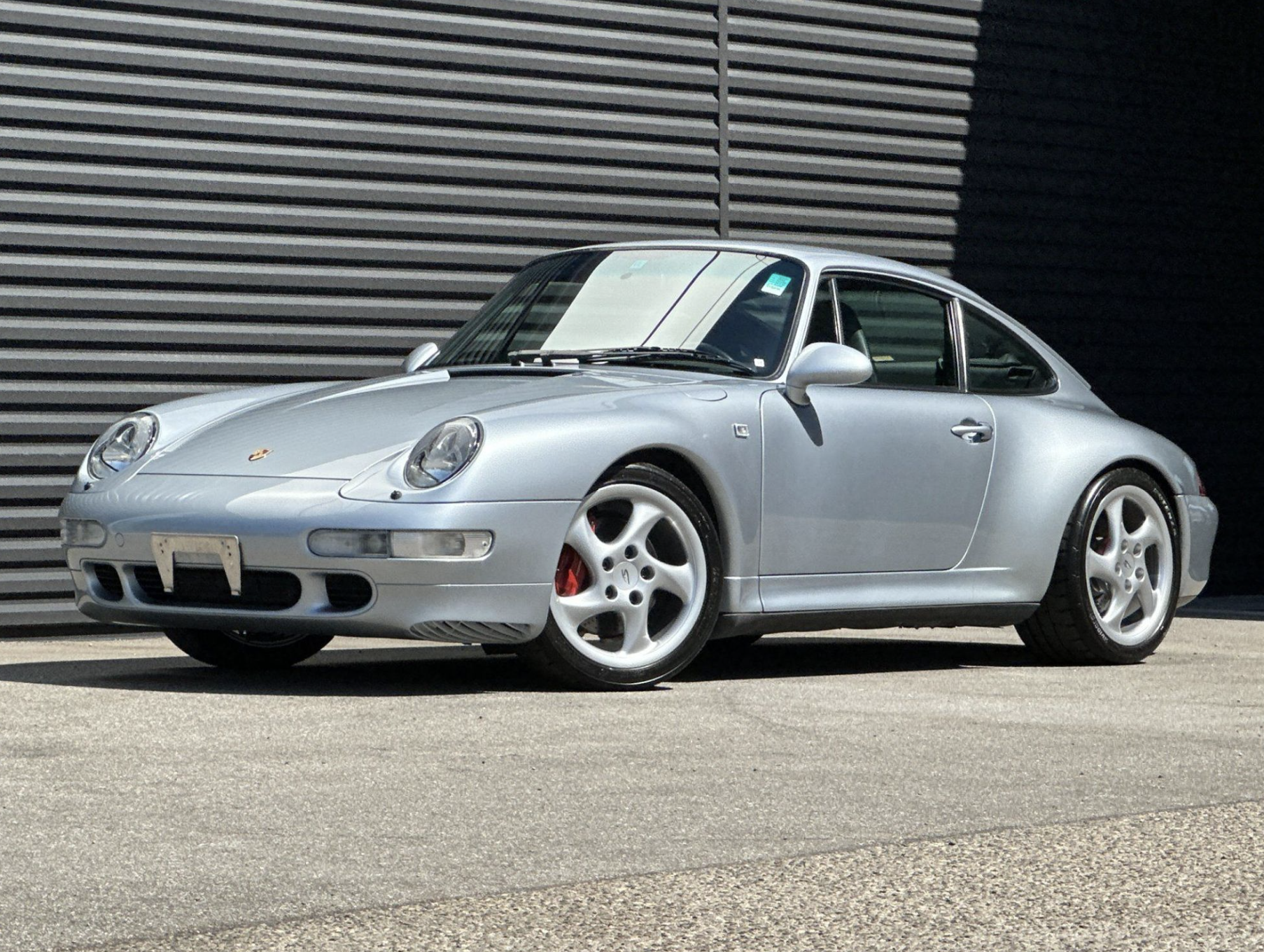
The 993 occupies an appealing place in the 911 story: familiar enough to feel connected to the earliest cars, developed enough to invite regular use. The rounded wings, compact cabin and five-dial dashboard give it an identity that is easy to recognise without a badge. Its appeal is also personal. Some buyers want the shape they remember from the 1990s; others are looking for a car whose controls make the journey feel like an occasion.
Produced from 1993 to 1998, the fourth-generation 911 was the last with an air-cooled engine. Porsche’s account of the model describes advances in handling and usability alongside that final evolution of the air-cooled flat-six. This is a family of quite different cars, however, so a useful search begins with the version. Porsche’s 993 overview.
Explore our illustrated guide to 993 models and variants for Carrera, S, 4S, Targa, Turbo, RS and GT2 differences, plus model years and options.
Versions
The rear-wheel-drive Carrera and all-wheel-drive Carrera 4 form the main starting points. Coupé, Cabriolet and glass-roofed Targa bodies give buyers different ways to experience the generation. The widebody Carrera S and Carrera 4S offer another visual direction; distinguish their driven wheels and equipment before comparing apparently similar cars.
Early and later cars also need to be identified accurately. VarioRam belongs to the later engine specification, while the Turbo introduces twin turbochargers and a different performance brief. Porsche’s own history is a useful starting reference, but a particular chassis should be matched to its factory and maintenance records. Porsche’s model chronology.
Our suggestion is to write a short description of the car you want before browsing: body style, transmission, intended use and the degree of originality that matters to you. That makes it easier to recognise a suitable example without letting every new listing change the brief. Leave colour and optional equipment flexible unless they are central to the reason you want the car.
Carrera S and Carrera 4S
The Carrera S is rear-wheel drive; the Carrera 4S is all-wheel drive. Both are naturally aspirated, wide-body 993 coupés. The regular Carrera is also rear-wheel drive, while the Carrera 4 combines all-wheel drive with the narrower body. These are separate choices: driven wheels and body width do not always go together. Porsche’s 993 model history.
The 4S has more in common with the Turbo than its broad rear arches: it also uses Turbo-derived chassis equipment and the larger Turbo braking system, with the familiar red calipers often called “Big Reds”. It retains a naturally aspirated Carrera engine and a retracting rear spoiler. The Carrera S should not be assumed to have the same brakes simply because it shares the wide body. The period Carrera 4S road test and Carrera S road test document different brake specifications.
Read our narrow-body versus wide-body guide and Carrera S versus Carrera 4S comparison for the distinctions that matter when choosing and inspecting a car.
A little more clarity
Common questions
Is every rear-wheel-drive 993 a Carrera S?
No. The standard Carrera is rear-wheel drive too. The S identifies a particular wide-body version; the Carrera 4 and Carrera 4S are all-wheel-drive models.
Where should I start if I have never owned a 993?
Decide how you plan to use it and try the body style and transmission that interest you. Speak to an independent specialist before viewing, then use our Carrera buyer’s guide to prepare your questions.
Does a rare colour make a car a special edition?
A colour alone does not authenticate an edition. Ask for the original specification and documentation connecting the chassis to the claimed series.
Is an older restoration a reason to reject a car?
Ask what was done, who did it and what the car needs today. Review the photographs and invoices with the inspector. The age or price of the work cannot establish its quality on its own.
Living with a 993
Think about the ordinary journeys as well as the memorable ones. Try the seating position, visibility, parking manoeuvres and controls. If you want an opening roof, spend time with its operation and the cabin when it is closed. If another person will regularly travel with you, bring them to the viewing. A car that fits the way you live is more likely to be used and enjoyed.
Choose a workshop before you choose a car. Ask about access to parts, diagnostic capability and recent experience with the version on your shortlist. A useful conversation covers routine maintenance, how the shop documents findings and how it approaches uncertain problems. You should know who will help you understand the first unexpected noise or warning light.
Originality & rare cars
Originality has several separate meanings. The engine, gearbox, paint, interior and equipment can each tell a different story. Ask what remains as built, what has been repaired and what has been changed. A thoughtful modification may suit your plans; its value to you depends on the workmanship, documentation and whether you would want to keep it.
The RS and GT2 require a more specialised search. Porsche’s account of the first GT2 describes its motorsport purpose and the combination of turbocharged performance with weight-saving measures. Authentication should include the chassis and original configuration as well as the history of subsequent use. Porsche’s GT2 history.
A striking colour such as Vesuvio should lead to a conversation about original paint specification and any claimed edition. Ask for the documents that connect those claims to the individual car. We keep colour, factory options and verified special-series identity separate rather than treating one as proof of another.
Buying one
Our full Carrera buyer’s guide walks through the history file, body inspection, engine checks, compression and leak-down testing, road test and budget. The central question is how well the evidence explains the car in front of you. Keep the seller’s statements, documented work and the inspector’s findings distinct, then look for agreement between them.
Read the Porsche 993 Carrera buyer’s guide. It covers the naturally aspirated Carrera family; Turbo, RS and GT2 cars need an inspection tailored to their own specification. The reference photograph on this page illustrates the model and is not a listing for sale.